Browse 110+ Media and Streaming Appliances on the NetActuate Media Marketplace
Explore


Browse 110+ Media and Streaming Appliances on the NetActuate Media Marketplace

By clicking "Accept all" you allow cookies that improve your experience on our site, help us analyze site performance and usage, and enable us to show relevant marketing content. You can manage cookie settings below. By clicking “Confirm selection” you agree with the current settings.


NANOG 96 felt a bit lighter than usual, but the content still hit hard. AI is turning data centers into facilities projects, and on the public Internet side, BGP growth is starting to look like something you plan for without panicking.
Also, the espresso bar did a lot of heavy lifting this week.
I arrived Saturday and met up with some colleagues from Germany from various companies. We ended up at Cheesecake Factory, which they always seem genuinely excited about, and celebrated one of their birthdays. Not the most San Francisco-coded dinner choice, but it was a fun start to the week.
I attended the conference opening and the keynote, then came back after lunch for the main-room afternoon block. As a NANOG Program Committee member, I also emcee'd the sessions after lunch through the end of the day. It is a great counterbalance to my introverted tendencies, and it keeps me engaged in different ways.
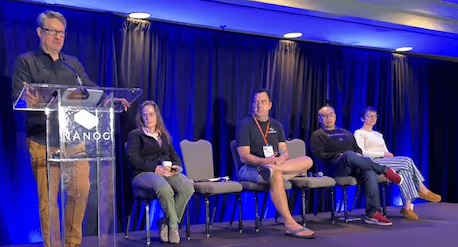
The keynote was a good reminder that the constraints are no longer just chips and optics—power and water are increasingly the real bottlenecks. The detail that genuinely surprised me was in-rack liquid cooling that leverages building water with facility water with the technology coolant systems kept separate. That is NOT where I expected a NANOG keynote to go, but here we are.
This was both technically interesting and unsettling. It illustrated how IPv4 address space previously originated by Ukrainian networks has shifted to new origins, including large American networks and cloud providers, often enabled by leasing and brokerage.
The room reaction was especially strong around the suggestion that RIPE WHOIS history (WHOWAS and related object history) may be getting scrubbed or deleted in ways that make it harder to audit historical registration and changes. If accurate, that is a big deal for anyone who relies on that history to understand how and why a block "became what it is" over time.
This was my favorite talk of the day. It framed incident response as a discipline: how you form hypotheses, how you test them cleanly, and how you keep communication high-signal under pressure. It was the kind of talk that makes you want to be more intentional the next time something breaks at 3am.
The community meeting was a nice pulse check on the organization, and I was genuinely happy to see the improvements to the NANOG website. The search functionality in particular is a big upgrade. It is much easier to find the needle you need in a haystack of 96 NANOGs.
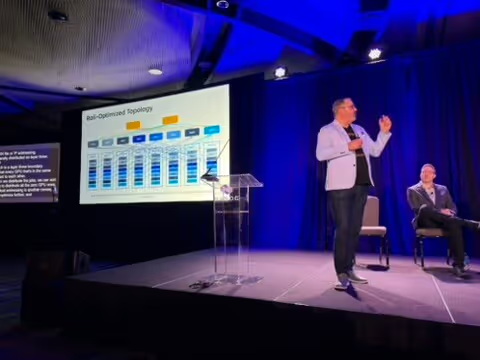
This talk reinforced the theme of the day: AI infrastructure is forcing new network design patterns, and it is not forgiving. Between topology choices, congestion control, and the operational reality of failures at scale, "just build a normal DC network" is not a plan. The monitoring and operations angle really matters here, because when you have enough optics, you effectively have failures as a steady-state condition.
I stopped into the Peering Coordination Forum briefly, then had a customer dinner, and ended the night at the NANOG social at the Exploratorium. It is an interactive exhibit space, and it was just as entertaining as the conversations. A perfect venue for a room full of people who like to poke at systems and see what happens.
Tuesday was mostly the Members Meeting and then the hallway track for me. I had too many meetings during the day to catch many sessions live. I made it to Beer n' Gear before heading to a vendor dinner.
After the meeting, I left hopeful that I'll be reappointed to both the NANOG Program Committee and the NANOG Community Engagement Committee.
Wednesday always has a smaller audience, and this meeting was no exception. A lot of people leave during the last day to catch flights home without taking a red-eye.
Geoff's update was a reassuring data-driven reality check. The IPv4 and IPv6 table sizes have been relatively flat over the last year, and he made the case that we may be getting close to the peak of Internet table size. The practical implication, at least from a RIB and FIB scaling perspective, is that the routers we are deploying today should be in good shape for a while yet. In other words: plan, but do not freak out.
This was a useful reminder that even technical decisions are financial decisions once you put a budget, headcount, rack space, and timeline next to them. There was a lot to absorb, and I did not fully follow everything in real time, so this is one I will be rewatching, and I plan to dig into her GitHub repo.
After the conference wrapped, a few of us chatted about the meeting and why it still has so much value, and then headed to a vendor dinner.
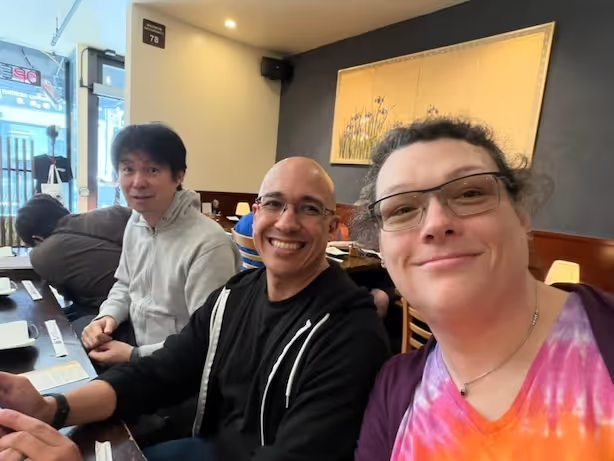
You can walk into NANOG expecting the "same old" and still end up finding something that blows your mind. This meeting was a good example of that: data centers are changing fast (especially with AI), and it is easy to miss just how much has shifted while you have been focused on a different slice of the industry.

.png)
.png)





.jpg)