Browse 110+ Media and Streaming Appliances on the NetActuate Media Marketplace
Explore


Browse 110+ Media and Streaming Appliances on the NetActuate Media Marketplace

By clicking "Accept all" you allow cookies that improve your experience on our site, help us analyze site performance and usage, and enable us to show relevant marketing content. You can manage cookie settings below. By clicking “Confirm selection” you agree with the current settings.


Global Peering Forum (GPF) 2026 started with a Sunday tour of Panama, and the weather felt hot and humid enough to make it a memorable way to begin the week. By Sunday evening, the social meetups had helped everyone get into conference mode—setting the tone for the rest of the week. The talks certainly mattered, but so did the chance to reconnect with familiar faces and the lively hallway track.
Monday opened with coffee and one of the most useful sessions of the week: Google Peering and Technical Policy. What made the talk useful was the way it translated peering policy into operator terms: traffic predictability, redundancy, latency, and the friction that shows up when failover is not as clean as it looks on paper. It was a helpful explanation of the talk's case for Google moving toward more selective public IX policy, especially around route-server peering, and toward redundant private interconnection.
Another Monday highlight was Ben Cartwright-Cox's bgp.tools talk on BGP and traceroute disagreements. It was exactly the kind of session I enjoy most at events like GPF: technically grounded, operationally useful, and focused on the messy reality of how networks actually behave. One of the strongest takeaways was that BGP and traceroute are not necessarily competing truths. They are different instruments describing the network from different angles, and the interesting part is what you can learn when they disagree. I found the bgp.tools feature he showed, which is already in beta, especially interesting and am looking forward to spending more time with it.
Monday also reinforced what makes Peering Forum events so valuable in the first place. The scheduled bilateral talks were useful, but some of the best conversations still happened in the hallways between sessions.
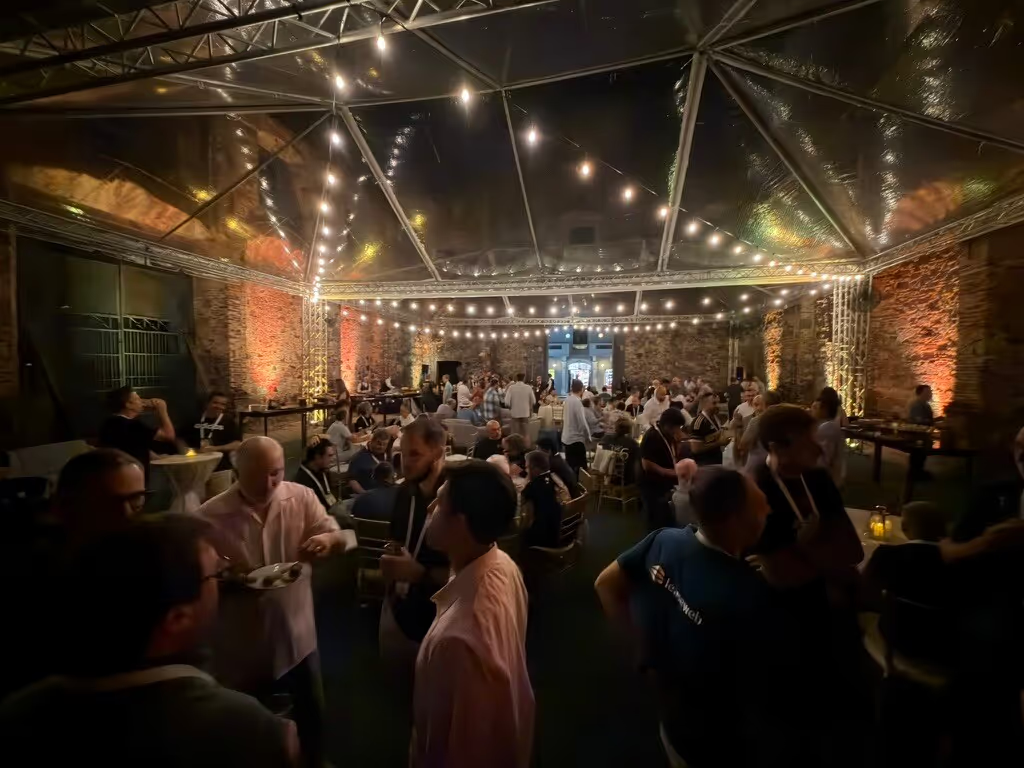
Tuesday was one of those conference days where the schedule was strong, but the conversations around it were just as active. The AI Peering Exchange panel was the talk of the town afterward, which is usually the best sign that a topic has legs. What stood out most was not a single takeaway so much as the fact that it clearly surfaced a live question for the interconnection community. I hope it is a discussion that keeps showing up at future conferences.
I also spent time on bilateral meetings, which again turned out to be one of the parts of the event that mattered most. One conversation I came away interested in was LINX's new Internet exchange in Accra, Ghana, where NetActuate is looking forward to being one of the first members and helping improve African community Internet connectivity performance with Anycast.
Tuesday evening added a nice bit of human texture. I spent a short time at the social and then took a walk through Casco Antiguo before dinner. It was a good reminder that conference cities have their own rhythm after the badge comes off, and Panama certainly did.
Wednesday closed the formal program with some of the more thought-provoking sessions of the week. One of the standout talks for me was Jacomo Piccolini of Team Cymru speaking on the challenges residential proxies create for ASN operators. Without getting into the more sensitive details, the high-level takeaway was clear: this affects everybody, and it is likely to get worse as more AI systems use residential proxies to gather context and local data. It was one of the strongest reminders of the week that Internet infrastructure abuse is not abstract. It reaches into security, abuse handling, reputation, and network hygiene in very practical ways.
Ritesh Mukherjee's talk on route validation treated RPKI and validation as an ongoing operational practice rather than a box to check once and move on from. That framing felt right. The shift around RPKI over the last five years has been significant, and "done" is not really the right word for this kind of work.
Conclusion
By the time the conference closed, it felt like GPF had done what a good Peering Forum should do: good talks, productive side conversations, and enough face time to make the trip worthwhile. I wrapped up the trip by spending a little more time exploring Panama before heading to the airport, and I left with a few ideas I want to keep following, including the AMS-IX initiative discussed in the Black Mirror Concept talk. I'm already looking forward to GPF 2027 in Calgary, Alberta, Canada, April 4 through April 7, 2027.

.png)
.png)






.jpg)