Browse 110+ Media and Streaming Appliances on the NetActuate Media Marketplace
Explore


Browse 110+ Media and Streaming Appliances on the NetActuate Media Marketplace

By clicking "Accept all" you allow cookies that improve your experience on our site, help us analyze site performance and usage, and enable us to show relevant marketing content. You can manage cookie settings below. By clicking “Confirm selection” you agree with the current settings.

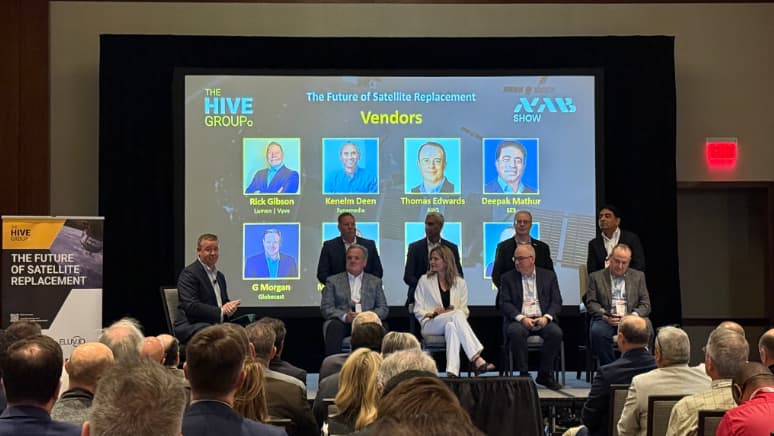
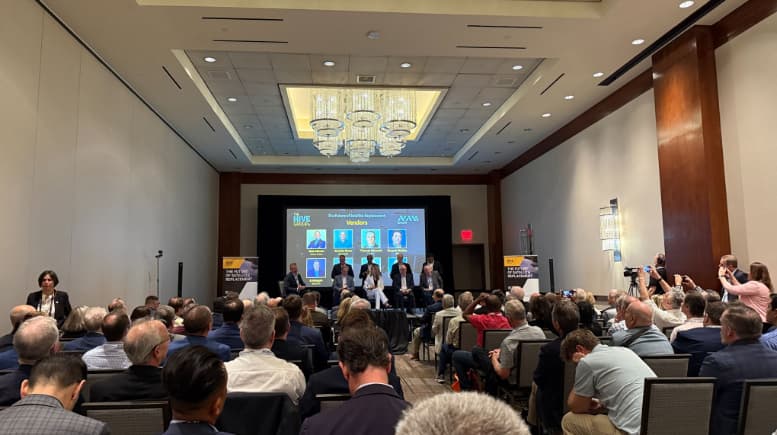
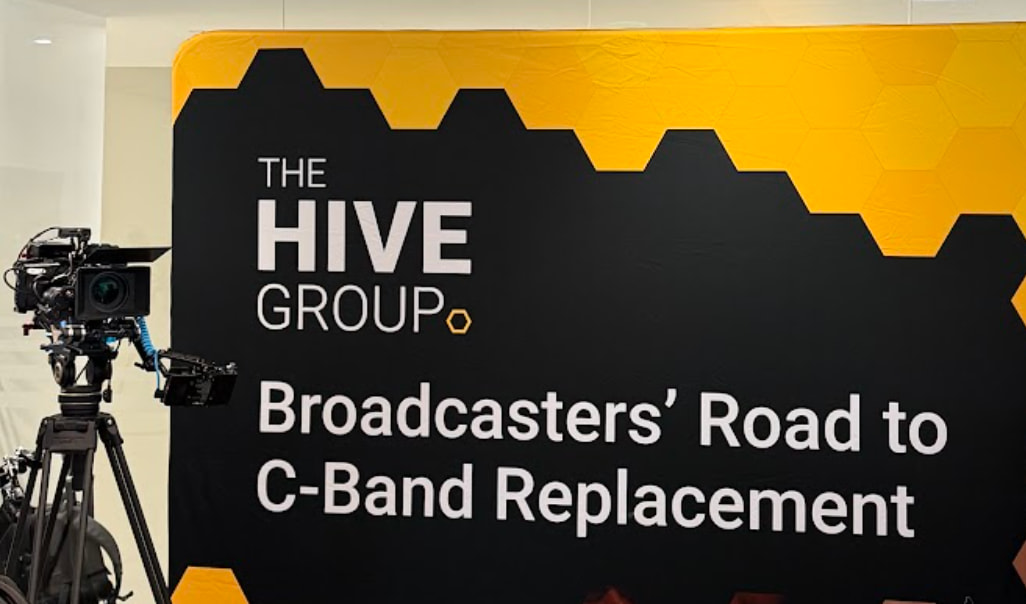
On Tuesday morning of NAB, I attended the Hive Group's breakfast event at the Renaissance Las Vegas, The Future of Satellite Replacement. Two hours, ten speakers from across the broadcast and vendor ecosystem, one topic: What the US industry should do by the C-band transition deadline on July 24, 2027. I've been building network infrastructure for a long time, and I walked out of that room with a lot to think about.
A quick level-set for anyone new to this. Congress passed the One Big Beautiful Bill Act in July 2025, directing the FCC to auction at least 100 MHz of upper C-band (3.98 to 4.2 GHz) for 5G and future 6G services, no later than July 4, 2027. The FCC's Notice of Proposed Rulemaking, adopted November 20, 2025, formally opened the process. Final rules are expected by roughly mid-2026. That's a statutory deadline, not a planning horizon.
Hive Group's Lorenzo Zanni nailed the framing in the accompanying whitepaper, No Safe Harbor. This auction is structurally different from 2020's Auction 107. Back then, broadcasters displaced from the lower C-band had somewhere to go, the upper 200 MHz of the band, which is exactly where the current auction now targets. There's no further upper band this time. Every broadcaster displaced must migrate to a different distribution technology, not just a different frequency. Investments made in good faith after Auction 107 on the assumption that the upper band was protected are now potentially stranded.
As Rebecca Hanson, Director-General of NABA, put it in Hive's paper: "C-band is hands down the preferred transport for live events, due to its reliability and signal quality." The industry knows exactly what it's giving up. The question is what comes next.
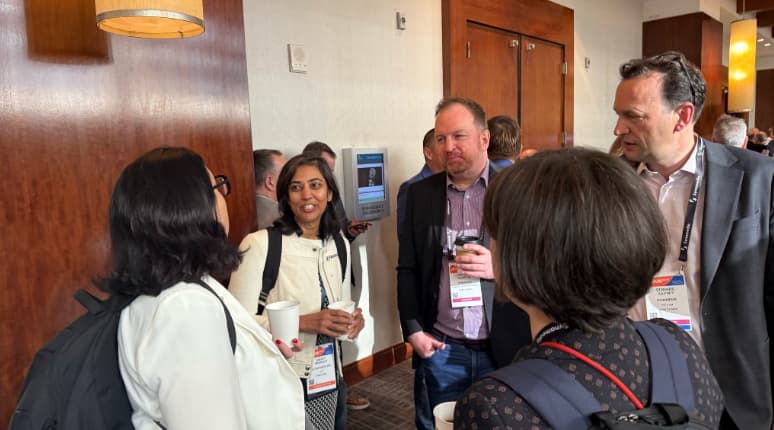
Every speaker on the panel said something worth writing down. In rough order:
Ken Fuller from Paramount/CBS put the requirements in three words: quality, reliability, and availability. No single replacement technology satisfies all three on its own.
Alastair Hamilton from Fox Corporation pushed back hard on anyone pitching a single-transport answer. Fox's own data across the 90 US markets they measured shows that public internet with packet recovery does not deliver five-nines. Any architecture resting on a single IP transport underestimates the problem.
Brad Cheney from Fox Sports brought the affiliate reality. The top ten MVPDs are solved. It's the next 700 where the business case breaks down, where circuits aren't dimensioned for every major network's feeds arriving simultaneously as IP.
David Johnson from The Walt Disney Company kept coming back to economics and hybrid models. No silver bullet, and don't pretend there is one.
Rick Young from LTN brought the incumbent's numbers: 99.9999% availability, sub-200 ms latency, more than 1,400 broadcast stations live today, 80 million hours of live content per year. LTN is the benchmark right now for anyone building a replacement.
Kenelm Deen from Synamedia pointed at where the on-site footprint is heading. Synamedia's Quortex PowerVu update positions their Media Edge Gateway (MEG) as the minimum required on-site hardware for a national broadcaster with 200 to 250 affiliates. Software-based receivers, multi-protocol, hybrid ingest. The device layer is already built. What's still open is the network underneath that makes it all work reliably.
Alan Young from Zixi brought the scale numbers. Zixi software now processes 1.7 exabytes of video per year at 450 Gbps continuously, with SRT and RIST combined making up close to half of BBC's platform traffic. Application-layer reliability protocols are carrying real broadcast traffic at scale today.
Michelle Munson from Eluvio, who co-founded Aspera and understands this space as well as anyone in it, was the most architecturally ambitious voice in the room. Her Content Fabric Protocol isn't positioned as just a satellite replacement. It's a decentralized any-to-any video distribution system with sub-500 ms global latency and SMPTE 2022-7 multipath built in.
Thomas Edwards from AWS and G Morgan from Globecast rounded out the discussion with the hyperscaler and global-services perspectives.
Every one of those companies is also a sponsor of the Hive event. So is Vyvx / Lumen, so is Amagi. The commercial landscape for C-band replacement is already formed. The question is how the pieces connect.
Three things.
The replacement is a hybrid, not a single technology. Fiber will carry the bulk, but 5G, LEO, and Ku-band IP backhaul all have a role. Anyone pitching one answer is underestimating the problem.
The last mile is where this is won or lost. In one of the partnership conversations at NAB, a Synamedia engineer pressed me hard on this, and he was right to. A "dual diverse fiber" pitch is meaningless if both fibers share the same trench. For the rural long tail where a second fiber genuinely doesn't exist or costs $12 a foot for the trenching, real availability diversity has to come from combining transport classes with independent failure modes: fiber plus 5G, plus LEO, plus Ku-band backhaul. That's the bit everyone wants to hand-wave past, and you can't.
There is no application-layer fix for a bad underlay. Every reliability protocol on the panel (SRT, RIST, Zixi) runs on top of an IP network. The better the network underneath, the less work those protocols have to do. A well-engineered network edge gives you more predictability, scalability, latency and resilience than any protocol should need to fix on top. It starts with the network.
I'm not going to turn this post into a product pitch. The short version: NetActuate operates one of the largest IPv4 and IPv6 networks by peer count with 22 edge locations in carrier hotels across every major US market (and 50+ edge locations total globally). We've spent the last decade as the infrastructure partner for companies doing hard network things.
Our C-band transition posture is deliberately narrow: infrastructure only, never a competitor to the vendors operating at the layers above us. LTN, Synamedia, Eluvio, Zixi, AWS, and the rest of the companies on the Hive panel run on IP. A well-engineered anycast edge is a substrate each of them can sit on top of, with per-customer routing policy, engineered latency, real last-mile diversity, and the kind of multi-carrier flexibility the NAB conversation said every affiliate is going to need. That's the role we want to play.
What we're building for this transition is a partner-first network substrate, designed with the last-mile diversity problem rural affiliates actually face rather than the version of it that sounds good in a deck. We see this moment as an opportunity to stitch the ecosystem together underneath, with the application and device layers left to the vendors who own them. If your team is working on any piece of this and wants to think through where an Anycast edge fits, we'd like to talk.
Hive's closing recommendation is the right one. The period before the FCC finalizes rules isn't a waiting room. It's the most important window in the entire transition. Affiliate mapping, vendor pressure-testing, and multi-scenario cost modeling all take time, and there's less time left on the statutory clock than the industry has gotten comfortable assuming. The organizations that begin now will, as Hive puts it, define the terms of the transition.
If you're on a team working any piece of this, reach out. The contact form at netactuate.com/c-band-transition reaches me and my engineering team directly.

.png)
.png)







.jpg)
