Browse 110+ Media and Streaming Appliances on the NetActuate Media Marketplace
Explore


Browse 110+ Media and Streaming Appliances on the NetActuate Media Marketplace

By clicking "Accept all" you allow cookies that improve your experience on our site, help us analyze site performance and usage, and enable us to show relevant marketing content. You can manage cookie settings below. By clicking “Confirm selection” you agree with the current settings.


The FreeBSD Enterprise Working Group (EWG) fielded an online survey from April 24 to May 8, 2026 to measure the level of satisfaction among enterprise users of FreeBSD and the “on-the-ground” effectiveness of EWG work over the past three years. We also used the survey to understand current friction points and prioritize the EWG’s ongoing work.
Begun in 2023, the EWG set out to bring clarity to feature and other gaps that could limit enterprise adoption of FreeBSD as a general-purpose enterprise server platform, and to provide a supportive group to help developers close the gaps.
The group established the following success metrics:
In the November 2025 Update, we documented progress on success metrics 1 and 3.
This survey measured progress on success metric 4.
Let’s dive deeper into each of these findings.
As the first satisfaction survey dedicated to enterprise FreeBSD users, this NPS score will serve as the benchmark. It’s safe to say we’re setting the bar high. In the tech space, an NPS over 50 is considered excellent.
We calculate NPS by asking how likely a respondent is to recommend the subject in question to a friend or colleague. The 0 to 10 scale pins 0 as ‘not likely’ and 10 as ‘extremely likely’. To calculate the score, you sum the percent of respondents that give a 9 or 10, these are your “Promoters” and subtract the sum percents given for 0 through 6, the “Detractors”. Hence the term ‘Net Promoter Score’.
For the 2026 FreeBSD in the Enterprise survey, the equation looks like this:
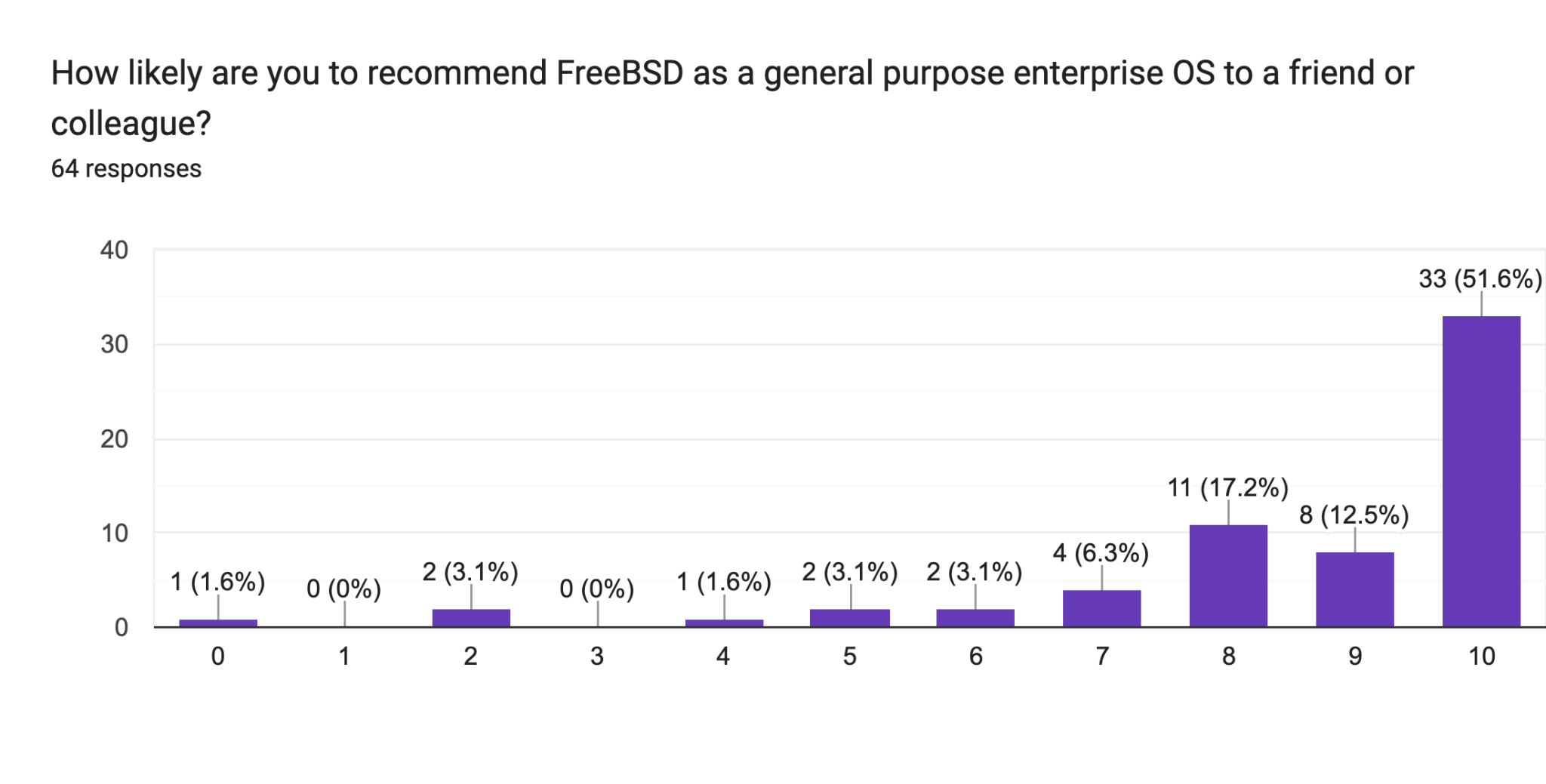
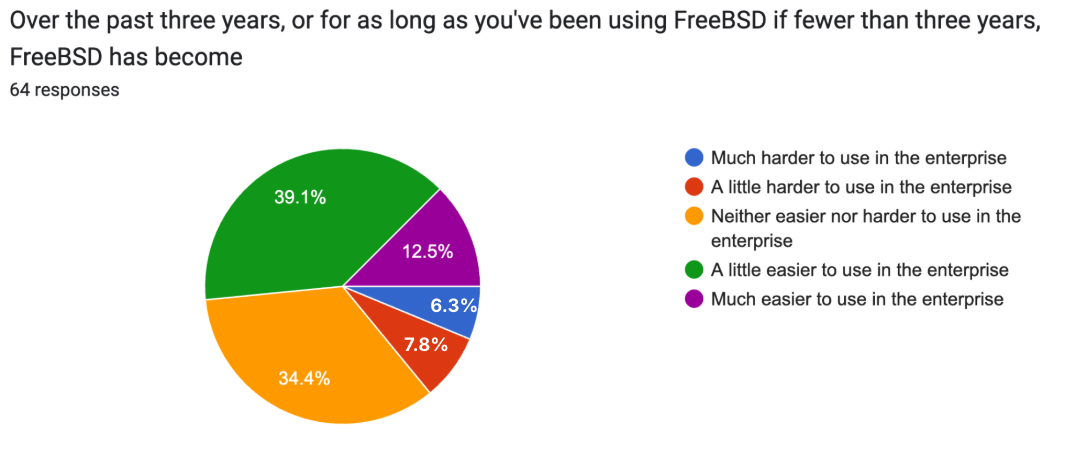
While NPS measures user satisfaction and loyalty, we also wanted to uncover whether enterprise users are finding FreeBSD easier to use. Encouragingly, a majority (52%) of respondents report that FreeBSD is becoming easier to use in the enterprise, and another 34% say it is holding steady, reporting its use is neither easier nor harder.
As shown in Figure 2, the largest group of respondents (39.1%) report that FreeBSD has become a little easier to use in the enterprise over the past three years while the EWG has been at work. The next largest group (34%) say it’s holding steady. Given tech’s accelerating pace of change, that’s more than treading water. The next largest segment, 12.5% of respondents, say FreeBSD is much easier to use in the enterprise. 14.1% say FreeBSD is a little (7.8%) or much (6.3%) harder to use in the enterprise. Note that this percent nearly perfectly matches the 12.5% of respondents coded as Detractors ← this is the kind of check I like to do that increases my confidence in the fidelity of the report.
We also wanted to know which, if any, of the specific EWG workstreams contributed most to improved usability. This gave me a chance to use the Google Form Skip Logic feature, or what they call “Go to section based on answer”.
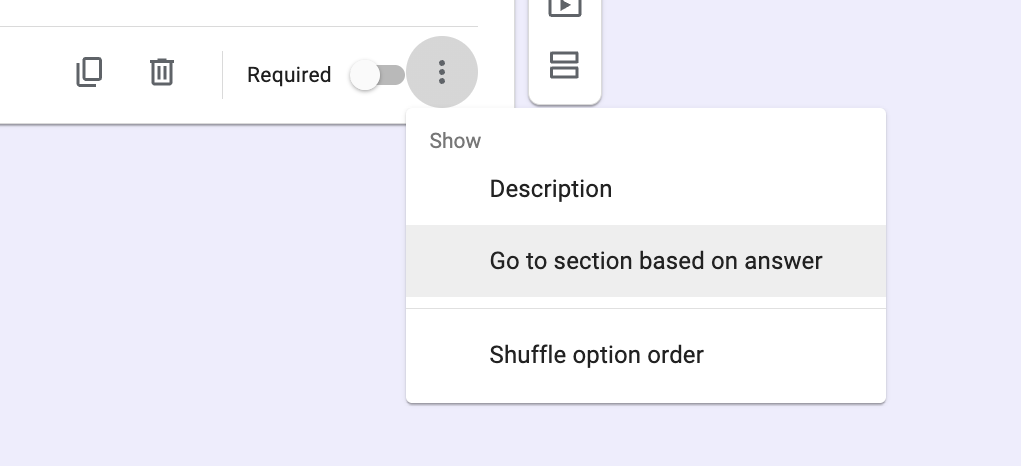
One of the fun parts of survey design is thinking not just about the questions you want to answer, but also how to “code” the survey to target specific questions at the best respondents.
I decided to ask anyone who reported that their experience with FreeBSD in the enterprise has become easier over the past three years “What has helped you the most? Rank these items by helpfulness to you, with 1 being most helpful and 7 least.” (There are two pearls of wisdom in here from Polly Staman, my survey sherpa. First is “close all questions that you can” meaning if you have a decent idea of the universe of likely responses, list them as response options instead of just giving people a text box. This will make the results more meaningful and MUCH easier to analyze, especially as the response count climbs. Second, if it makes sense, force people to rank the options, as this gives you greater clarity on the options’ relative importance.)
As we see in Figure 4, there’s one clear, undisputed heavyweight champion here. Let’s hear it for Sylve bhyve and Jails manageability! This is a great opportunity for the entire FreeBSD community to take a victory lap: Hayzam Sherif, the maintainer of Sylve, the FreeBSD Foundation for recognizing the importance of bhyve manageability to enterprise adoption and providing funding to support the development of Sylve, and the FreeBSD community that has rallied around Hayzam and this project. Sylve now counts nearly 1,000 GitHub stars and 14 contributors. Anyone looking for a great case study in community-driven enterprise open source should look right here.
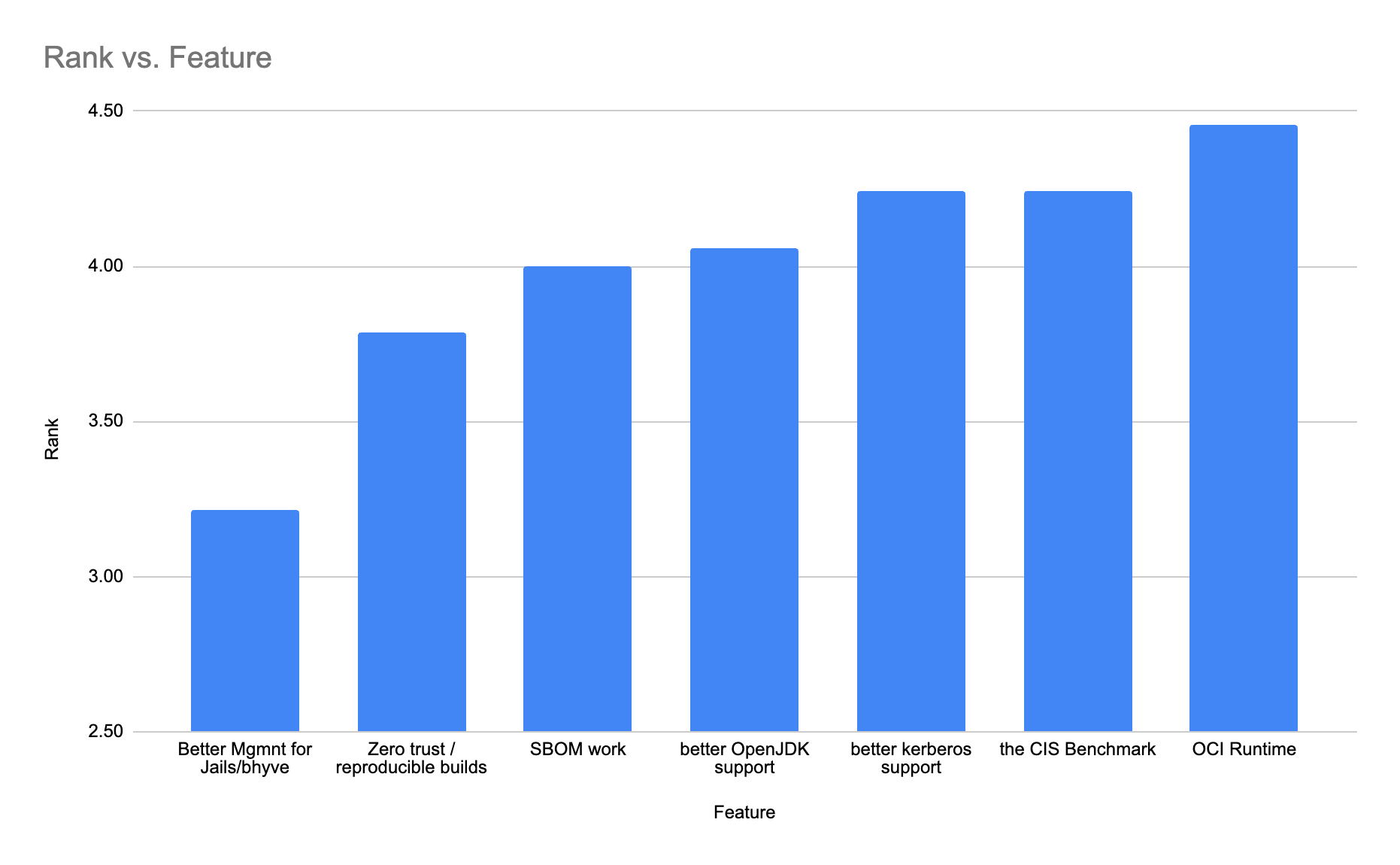
Zero Trust / Reproducible Builds and SBOM, ranking second and third, were key parts of the modernization work funded by the Sovereign Tech Agency. These capabilities, which are mostly in place now and will be fully available by FreeBSD 16, support enterprise users by improving software supply-chain verifiability and transparency. FreeBSD release artifacts can now be built reproducibly and without root privileges, including installer, memstick, VM, and cloud images, reducing privileged operations in the build pipeline while making identical source inputs produce byte-for-byte identical outputs.
The FreeBSD SBOM effort builds a source-focused framework around SPDX Lite 3.0.1 JSON-LD generation, SPDX-License-Identifier coverage, and SBOM metadata. For enterprises and FreeBSD-based vendors preparing for the CRA, these support auditing and compliance review.
FreeBSD’s integrated operating-system model gives its supply-chain work a clear artifact-level focus. Because the kernel, base system, release tools, and release artifacts are developed within a single OS project, reproducibility and no-root release engineering can be applied to the complete images that enterprises and vendors actually deploy, including ISO, memstick, VM, and cloud disk images. This is a distinction from the Linux ecosystem, where comparable supply-chain work (like other things) is spread across kernel, distribution build systems, package archives, container pipelines, and vendor-specific release processes. The point is not that one model is categorically better, but that FreeBSD’s project structure may make it easier to discuss transparency and verifiability at the level of complete operating-system release artifacts. This seems like a very fertile area for additional research, ideally by a disinterested party.
Just as with the previous section, I asked all the respondents that said FreeBSD has become harder to use to rank what would make it better.
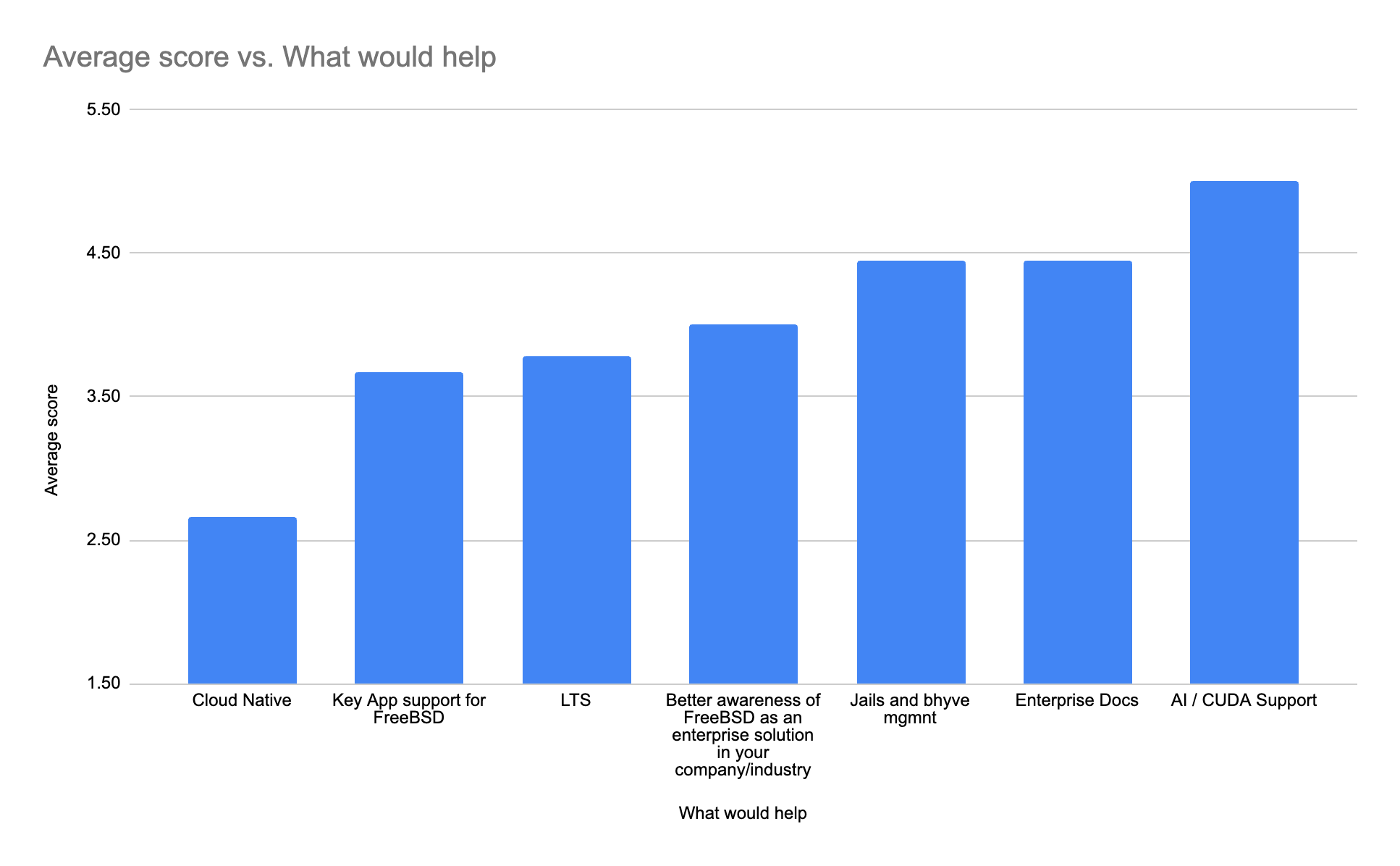
As detailed in the November 2025 EWG Update, Cloud Native officially graduated from the EWG with the creation of its own dedicated Cloud Native Container Technologies WG. I join the bi-weekly meetings when I can, and the group is making steady progress. If you’re reading this and you can help by contributing time or funding to accelerate FreeBSD cloud native efforts, please join the next meeting.
Second and third most wanted are what I’d call “ecosystem” capabilities. These aren’t features to be built into FreeBSD per se, but rather they refer to broader support needed to make FreeBSD go down easier in complex environments.
This one is a bit of a chicken and egg situation, but there are concrete steps the FreeBSD community can take now.
With the shortening of the FreeBSD release cycles, an LTS offer roughly similar to the Linux LTS offerings from Canonical, Red Hat, and SuSE would reduce friction. Klara, the provider of enterprise development and support services for FreeBSD and OpenZFS, is accepting expressions of interest in a new LTS offering launching this fall.
Respondents provided guidance on what would be most helpful for the EWG to focus on now, with most of the options falling in a pretty narrow band.
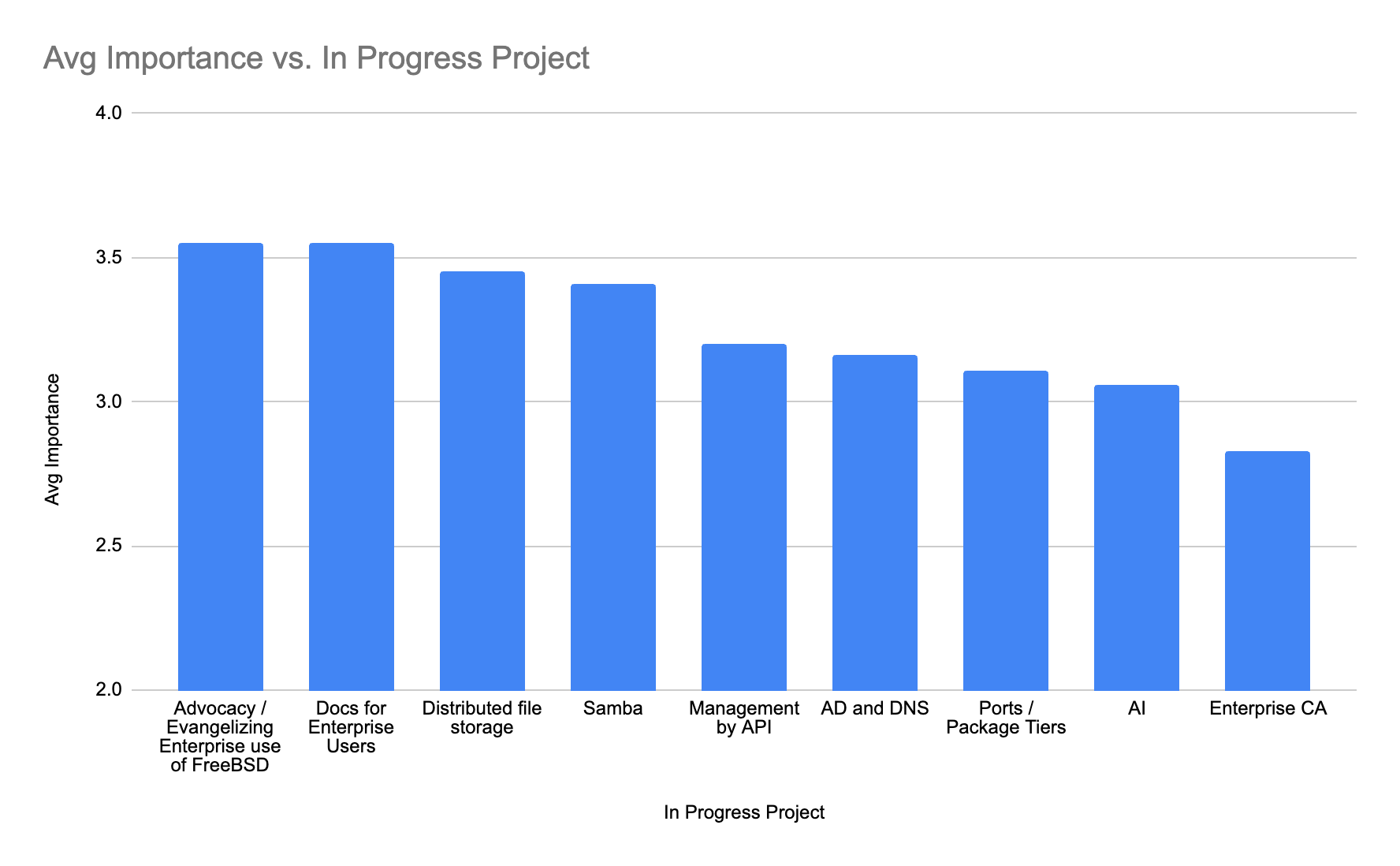
The desire for more evangelizing of FreeBSD come up often, so I wasn’t surprised that this emerged as the top priority for the EWG to focus on. My sense is the community has been improving in this regard over the past several years. There is also an interesting tension in this community on this point. The permissive “no strings attached” license seems to have created a culture that values, I’ll say, privacy, for lack of a better term. And like other highly-technical communities, there is a strong aversion to “fluffy” marketing. The downside to this is that it can lead to materials that work really well for existing users and very poorly for potential users–the quintessential “preaching to the choir” syndrome. All of this makes figuring out how to conduct the needed evangelism tricky. I will say that many of the FreeBSD Foundation's recent efforts seem right on the money, though they are, as they should be, spread across the entirety of the community, and not focused exclusively on enterprise use.
All “Promoter” survey respondents were offered the option to provide their email address if they are willing to help evangelize FreeBSD in the Enterprise. We received a good number, and I will be contacting them once I’ve got a plan for how to run the advocacy program. I’m also interested in collaborating with others in the community that may be interested in helping organize and execute an enterprise-focused advocacy program.
Beyond this, my plea is to simply tell your story. When I was at the Node.js Foundation, I worked with the late great Mikael Rogers on a YouTube Series called Enterprise Conversations. The format was super simple and honestly I think it works great. So, if nothing else, just write a LinkedIn Post with answers to these questions, or record yourself answering them:
There’s no real wrong way. Submit a talk to a conference, write a post on LinkedIn, or contact the FreeBSD Foundation to provide a testimonial.
The FreeBSD Handbook receives all kinds of well-deserved praise. What I hear in this result is that, for purposes of using FreeBSD in the enterprise, a set of configuration guides and how-tos specifically focused on common enterprise use cases would be an important supplement. I am willing to put effort into this, and if anyone is able to help fund this effort, it would allow me to contract a writer to assist. Others in the community are also working on this as well, such as members of the Cloud Native WG, and so my role may end up being in part an editorial one.
This comes up a lot in relation to cloud native workloads, and as such is a shared area of focus between the EWG and the Cloud Native WG. If this interests you and you’d like to help, please join the next Cloud Native WG meeting.

.png)
.png)







.jpg)