Browse 110+ Media and Streaming Appliances on the NetActuate Media Marketplace
Explore


Browse 110+ Media and Streaming Appliances on the NetActuate Media Marketplace

By clicking "Accept all" you allow cookies that improve your experience on our site, help us analyze site performance and usage, and enable us to show relevant marketing content. You can manage cookie settings below. By clicking “Confirm selection” you agree with the current settings.

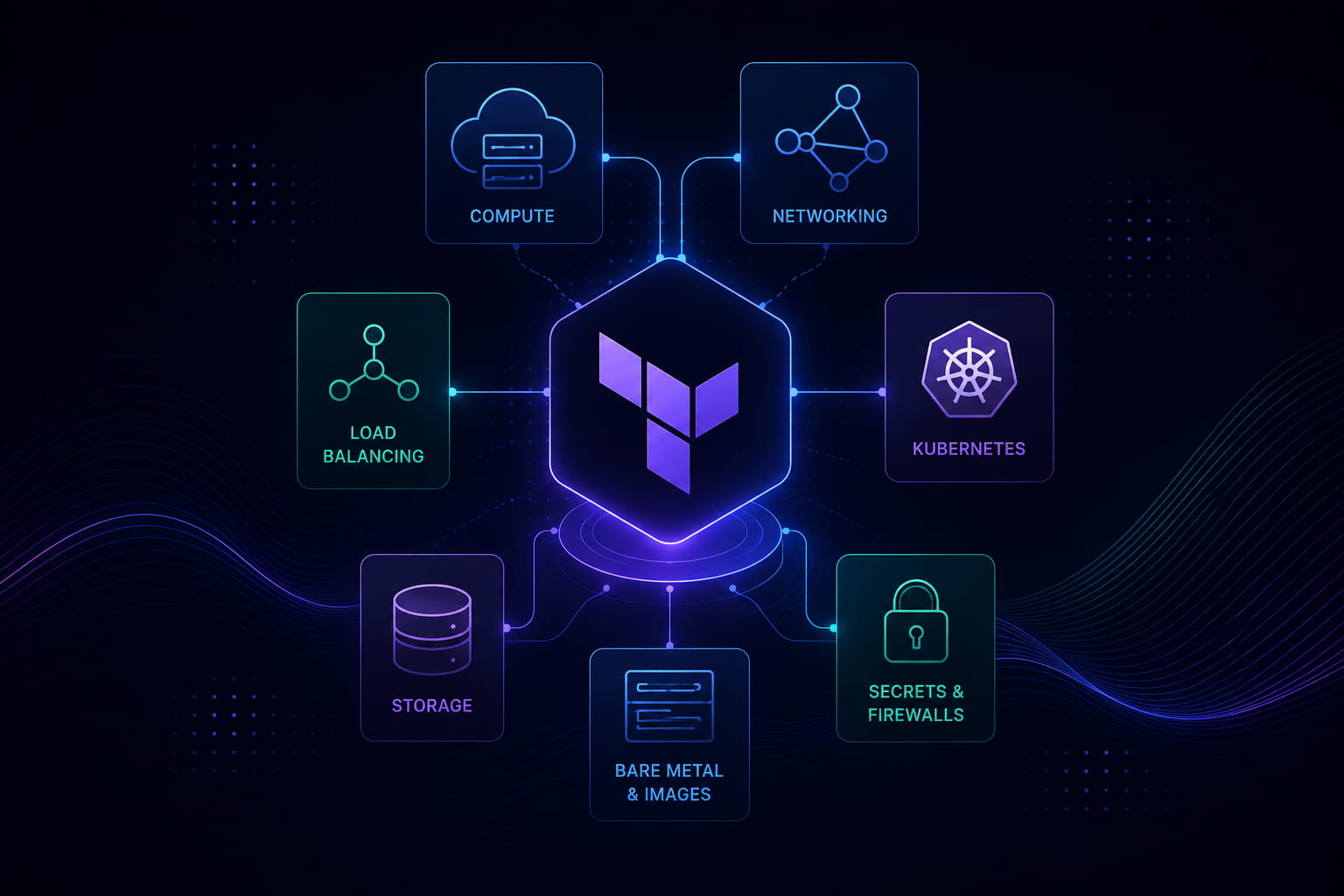
NetActuate has been working to expand our GoNA SDK and Terraform Provider beyond basic VM provisioning into a broader infrastructure-as-code toolkit for building edge, cloud, Kubernetes, storage, and networking environments.
The goal is simple: if you can design it as infrastructure, you should be able to declare it, review it, version it, and reproduce it with Terraform.
The netactuate_server resource now supports more complete lifecycle management for cloud VMs.
Server plan changes can scale in place when only the plan changes. Upgrades are handled automatically, while downsizes and ambiguous changes are gated behind allow_downsize_reboot so Terraform does not accidentally shrink or reboot a running server because of drift.
Server tagging is now first-class as well. You can declare tags directly on a VM:
tags = "api, production, sjc"
When configured, Terraform becomes authoritative for that server's tags. Missing tags are created automatically, tag order is normalized, and tag changes happen without rebuilding the VM.
We also added support for creating servers into a VPC (Virtual Private Cloud) at provision time. The workflow is explicit: create the VPC first, then build VMs into that VPC with vpc_id. The Provider exposes the VM's VPC private address through vpc_reserved_network and private_ip, which can then be used by backend pools and load balancers.
The Provider now includes a full VPC resource model.
You can declare isolated private networks with IPv4 and IPv6 ranges, DHCP nameservers, gateway firewall settings, default outbound SNAT, and managed bastion access. Once the VPC exists, Terraform can create backend VMs into it and wire them into internal services.
New VPC-related resources include:
netactuate_vpc
netactuate_vpc_ssh_key
netactuate_vpc_floating_ip
netactuate_vpc_backend_template
netactuate_vpc_gateway_dnat_rule
netactuate_vpc_gateway_snat_rule
netactuate_vpc_gateway_firewall_rule
On top of that, the Provider now manages both network and HTTP load balancer groups associated with VPCs.
Network load balancer groups support L4 forwarding with health checks and backend pools. HTTP load balancer groups add host/path routing, sticky sessions, active and passive health checks, SSL-to-backend, HTTPS redirect behavior, and TLS certificate support through netactuate_ssl_certificate.
This means a full private application pattern can now be described in Terraform: VPC first, backend VMs created into the VPC, private backend addresses exported into templates, public gateway IPs allocated, and load balancer groups routing traffic to those backends.
The Provider now covers both object and block storage.
For object storage, Terraform can create S3-compatible buckets and object stores, returning endpoints and credentials for applications, automation, or CI/CD workflows.
For block storage, Terraform can create Ceph RBD block namespaces and block volumes, exposing the information needed by clients and Kubernetes CSI workflows: monitors, pool, namespace, cluster ID, image name, and credentials.
New storage resources include:
netactuate_storage_bucket
netactuate_storage_object_store
netactuate_storage_block_namespace
netactuate_storage_block_volume
netactuate_storage_locations data source
Capacity expansion is supported where the platform allows it, while the Provider avoids implying unsafe bidirectional resize behavior.
NetActuate Kubernetes Engine is now represented directly in Terraform.
You can declare NKE clusters with Kubernetes version, location, worker plan, node bounds, autoscaling, dashboard settings, dual-stack options, and the required NKE billing contract. The Provider validates requested Kubernetes versions against the currently available version list, helping catch invalid version selections before provisioning.
New NKE resources and data sources include:
netactuate_nke_cluster
netactuate_nke_versions
netactuate_nke_kubeconfig
netactuate_nke_worker_nodes
The examples also show how NKE can be combined with Ceph RBD block namespaces to support Kubernetes persistent volumes through CSI.
The Provider now manages reusable firewall sets, firewall rules, and VM firewall relationships.
Firewall rule changes use the platform's draft/publish model under the hood. Terraform handles creating or reusing a draft, applying the rule change, publishing it, and optionally syncing the result to VMs. That gives users a declarative interface while preserving the safer staged workflow used by the platform.
Secrets are now supported with a simple two-level model:
netactuate_secret_list
netactuate_secret_list_value
This makes it easier to group credentials and generated values from Terraform-managed infrastructure, such as S3 keys, RBD credentials, application secrets, or integration tokens.
The Provider also gained custom image management. You can snapshot an existing server into a reusable image, update image metadata, delete images, and look up existing images through a data source.
Bare-metal provisioning is now represented through netactuate_metal, including dedicated device provisioning, OS profile selection, build scripts, disk layout, and build-status waiting.
There are also several quality-of-life improvements across the Provider:
Taken together, these changes move the NetActuate Terraform Provider from "create a VM" toward "declare an environment."
You can now model an edge VM with storage and firewall policy, a private VPC with internal backends and public load balancing, a managed Kubernetes cluster with persistent block storage, reusable secrets, custom images, and safer compute scaling behavior.
The GoNA SDK now backs these platform areas with typed operations, and the Terraform Provider turns those operations into repeatable infrastructure workflows.
Cloud Router and Magic Mesh deserve their own dedicated deep dive, so we'll cover those separately in the near future.

.png)
.png)




.jpg)