Browse 110+ Media and Streaming Appliances on the NetActuate Media Marketplace
Explore


Browse 110+ Media and Streaming Appliances on the NetActuate Media Marketplace

By clicking "Accept all" you allow cookies that improve your experience on our site, help us analyze site performance and usage, and enable us to show relevant marketing content. You can manage cookie settings below. By clicking “Confirm selection” you agree with the current settings.

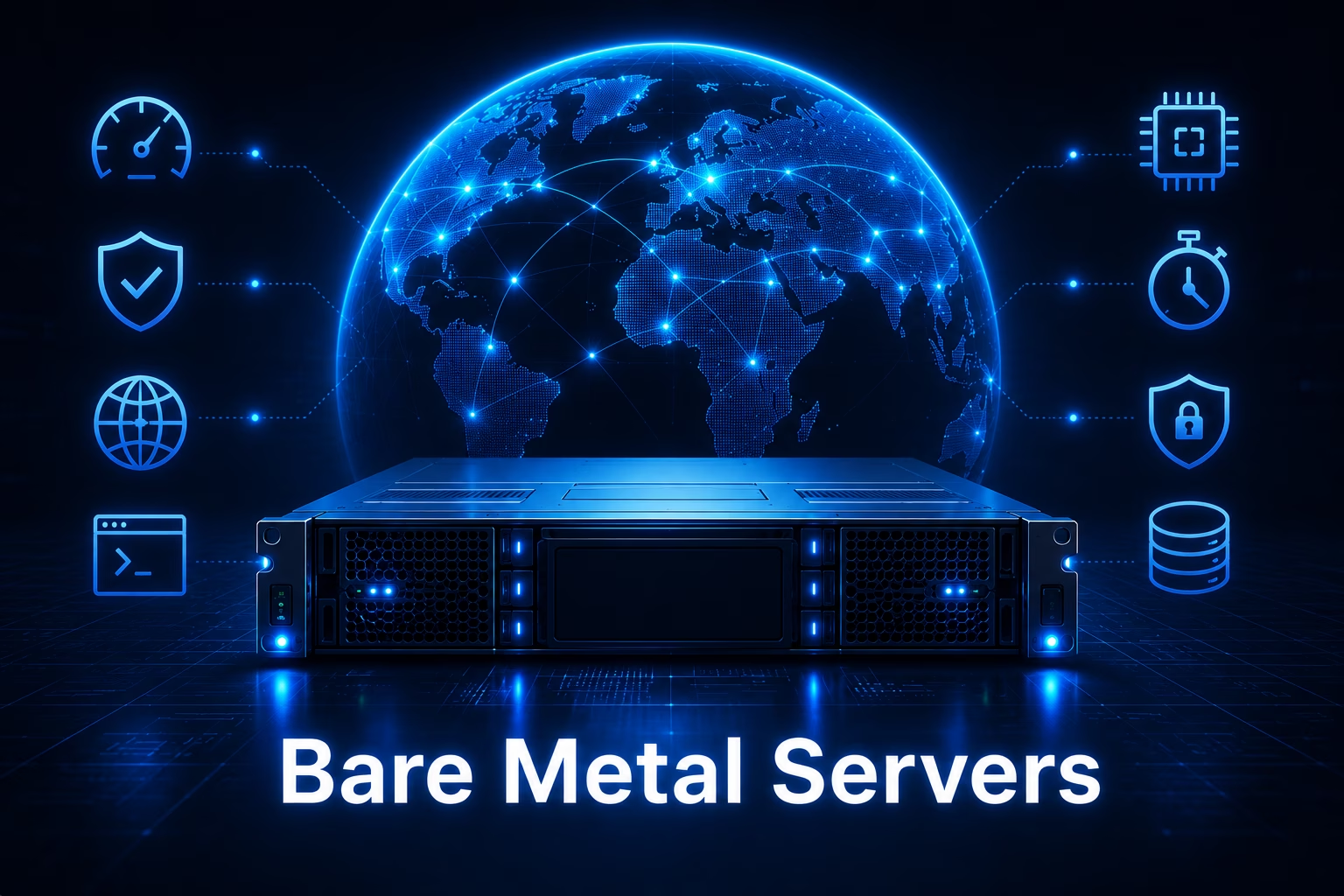
Every infrastructure decision starts with the same question: which compute layer does this workload belong on? The three candidates are always the same: dedicated bare metal servers, virtualized VMs, and containers. Pick the wrong tier and you pay in raw performance or wasted spend.
This guide resolves the bare metal vs virtual machine vs container decision with hard architectural data, a master comparison table, a streaming performance analysis, and a use-case matrix covering eight production workload types.
A bare metal server is a single-tenant physical server with no hypervisor. Every CPU cycle, byte of RAM, and IOPS belongs exclusively to one workload. No shared hardware. No virtualization overhead.
Without a hypervisor mediating resource access, there is no scheduler jitter from noisy neighbors, no memory balloon driver overhead, and no I/O virtualization tax. For latency-sensitive workloads, bare metal is the correct tier.
NetActuate bare metal servers deploy across 50+ global PoPs with BGP Anycast routing and automated provisioning via API, Terraform, and Ansible.
Need dedicated hardware with global PoP coverage?
Explore NetActuate Bare Metal Servers
A virtual machine (VM) is a software-defined compute environment running on shared physical hardware managed by a hypervisor. Multiple VMs run on one host, each with its own OS, isolated from other guests.
Virtual machines maximize hardware utilization. A host running at 40% for one workload can instead run eight VMs consuming proportional slices. The trade-off is overhead: Type 1 hypervisors (KVM, VMware ESXi, Hyper-V) add 5-15% overhead for compute-bound workloads and more for I/O-intensive ones.
On cost: bare metal carries a higher per-server price but zero shared-overhead waste for predictable, high-utilization workloads. VMs lower the per-unit cost by splitting one physical host across multiple tenants, but the hypervisor tax accumulates at scale on I/O-heavy workloads.
NetActuate VMs deliver predictable pricing, 10 Gbps port speed, built-in DDoS protection via Anycast, and deployment in minutes through the portal or API.
Hosted (Type 2) hypervisors run as applications on an existing host OS, adding a second software layer to every VM call. Bare metal (Type 1) hypervisors run directly on hardware with no host OS underneath. Type 1 delivers lower latency, higher VM density, and a smaller attack surface. All production infrastructure should use Type 1.
The hosted vs bare metal virtualization distinction is the most common procurement question when teams evaluate moving workloads from development to production. Type 2 stays in dev environments. Type 1 runs production.
A container is an isolated process running on a shared OS kernel. Container runtimes (Docker, containerd, CRI-O) use Linux namespaces and cgroups to isolate filesystem, network, and process trees without virtualizing hardware, delivering millisecond startup times and near-native performance.
Containers are not a replacement for VMs or bare metal. They run on top of them. NetActuate's managed cloud platform supports containerized workloads and Kubernetes orchestration on top of bare metal or VM compute, combining deployment velocity with infrastructure-level controls.
Bare metal wins on raw performance and security isolation. VMs win on resource efficiency and workload flexibility. Containers win on deployment speed and portability. The right architecture uses all three layers.
Not sure which tier fits your workload?
Talk to a NetActuate infrastructure engineer
Yes. Live streaming is CPU and network I/O-bound. Hypervisor CPU scheduler preemption directly degrades transcoding frame rates. Bare metal gives the encoder exclusive core access, consistent memory bandwidth, and direct NIC access via SR-IOV, eliminating the jitter that causes buffering events in streaming analytics.
The same constraint applies to high-frequency trading, gaming servers, large database clusters, and real-time analytics pipelines. In each case, tail latency is a product quality metric. Hypervisors introduce three variables bare metal eliminates: CPU scheduler preemption, memory balloon driver activity under host memory pressure, and virtual NIC overhead.
Match the workload to its dominant constraint: bare metal for performance-critical and latency-sensitive jobs, VMs for multi-tenant isolation and enterprise workloads, containers for microservices and rapid deployment pipelines.
Assign each workload to the layer matching its dominant constraint. Bare metal for the performance-critical layer. VMs for isolation and density. Containers for application delivery on top of either layer.
NetActuate's edge infrastructure runs all three tiers across the same global PoP footprint with BGP Anycast routing traffic to the nearest available resource. Teams evaluating cloud repatriation or hybrid builds can deploy across all three tiers on one platform without managing separate providers per layer.
For CPU-bound and I/O-bound workloads, yes. Bare metal eliminates hypervisor overhead, which ranges from 5% to 15% depending on workload type. For workloads that are not I/O-intensive, the performance delta is smaller and VMs may offer a better cost-performance trade-off.
A virtual machine runs a full OS per instance through a hypervisor, providing strong hardware-level isolation at the cost of 5-15% overhead and slower startup times. A container shares the host OS kernel, starts in milliseconds, and uses fewer resources, but provides weaker isolation. VMs suit multi-tenant enterprise workloads; containers suit microservices and CI/CD pipelines.
Yes. Running containers on bare metal without a VM intermediary eliminates one abstraction layer and is the preferred architecture for latency-sensitive containerized workloads.
Hosted (Type 2) hypervisors run on a host OS, adding a second software layer. Bare metal (Type 1) hypervisors run directly on hardware. Type 1 delivers lower latency, higher VM density, and a smaller attack surface. All production deployments should use Type 1.
Bare metal costs more per server than a VM slice but eliminates the hypervisor overhead tax. For high-utilization, I/O-intensive workloads running continuously, the per-unit cost of bare metal is lower than paying for a VM tier that wastes 5-15% of every compute cycle to the hypervisor.
Bare metal, VMs, and containers are complementary layers of a modern edge infrastructure stack. Bare metal for maximum performance. VMs for workload isolation. Containers for deployment velocity.
For streaming, HFT, GPU workloads, and database clusters where consistent performance is a product requirement, bare metal is not a legacy choice. It is the tier that eliminates the variables hypervisors introduce. The right architecture layers all three, each workload on the compute tier that matches its dominant constraint.
Deploy on dedicated bare metal across 50+ global PoPs.
Talk to a NetActuate infrastructure specialist
Evaluating a hybrid or cloud repatriation build?
Explore NetActuate Consulting Services

.png)
.png)





.jpg)