Browse 110+ Media and Streaming Appliances on the NetActuate Media Marketplace
Explore


Browse 110+ Media and Streaming Appliances on the NetActuate Media Marketplace

By clicking "Accept all" you allow cookies that improve your experience on our site, help us analyze site performance and usage, and enable us to show relevant marketing content. You can manage cookie settings below. By clicking “Confirm selection” you agree with the current settings.


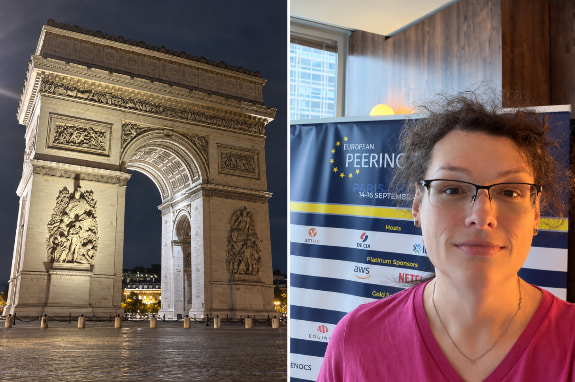
EPF 2026 brought me to Paris for the first time, with the event held at the Pullman Paris Montparnasse. Between the technical program and a busy meeting schedule, there was plenty to discuss. I also finally had a chance to see the Eiffel Tower. Until this trip, my reference point was Las Vegas, so an update was overdue.
Sunday
EPF started on Sunday evening with a meet-and-greet at the venue. Most attendees were there, and it gave us a chance to chat in a relaxed setting before the long week of talks and meetings ahead. Organizers of this year's event included AMS-IX, DE-CIX, LINX, and Netnod.
Monday
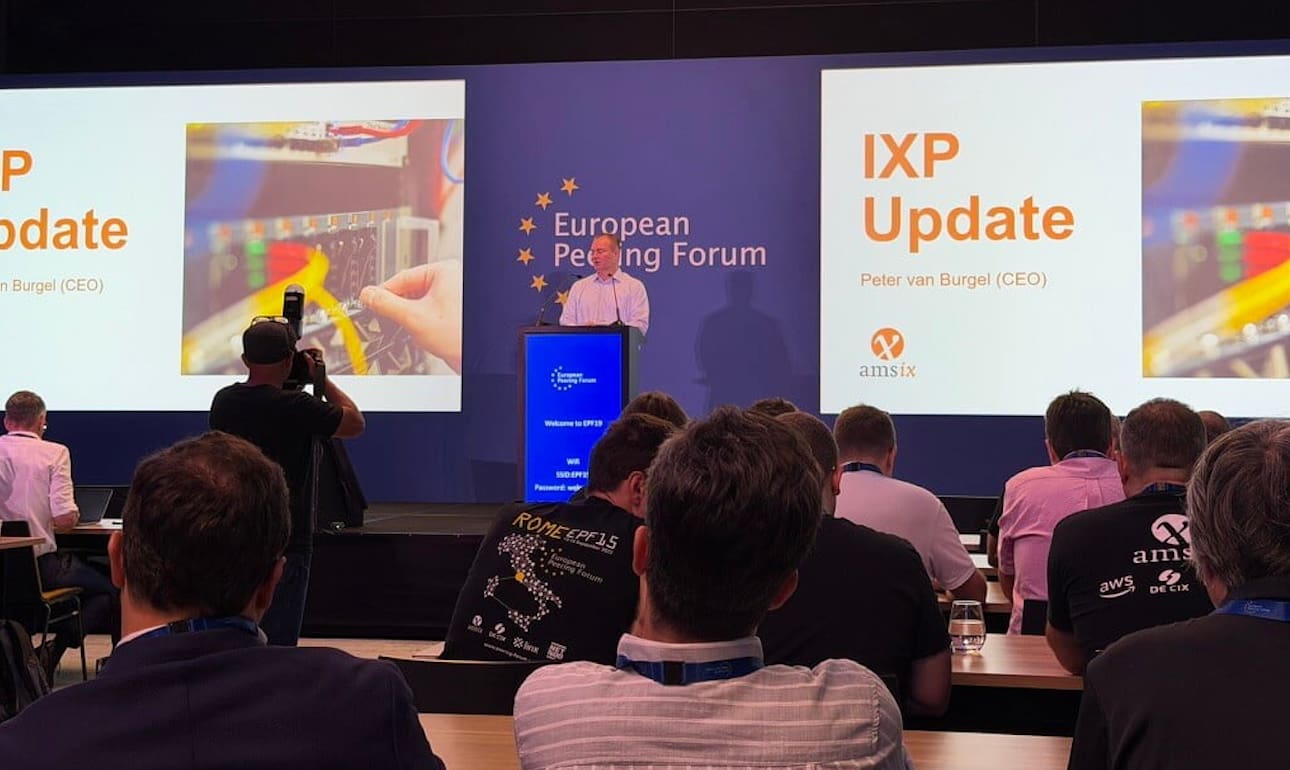
Monday's opening got the conference off to a great start with Hanna Kreitem's talk, “The Peering Disconnect: Rethinking IXPs in the Age of PNIs and Cloud Interconnection,” drew a queue of people with questions. The changing role of public peering was clearly a subject people wanted to discuss.
Dominique Schaeffer's session on attacks arriving through peering ports caught my attention for a very practical reason. We often receive attack traffic over peering, but the mitigation options available through a transit provider are not necessarily available through a peer. Having RTBH available on transit does not mean we can use the same approach on every path carrying an attack. The session touched on a problem that comes up in the networks we operate, which is exactly the kind of discussion I come to these events for.
The afternoon meetings covered existing interconnections, possible new locations, and ways to work more closely with partners. Some conversations also started outside the meeting slots. On the way to Monday's social, I sat next to Benjamin Deveaux from Workonline, and we got a good start on our discussion before our scheduled meeting the following day.
The social at Noti Club had a great view of the Eiffel Tower. I later headed out with colleagues for dinner, adding some time together outside the conference schedule.
Tuesday
Tuesday morning's talk from Mike Blanche, “The Digital Networks Act: Implications for IP Interconnection,” was one I wanted to spend more time on. He contrasted the European Commission's stated goals of simplification and competitiveness with what he sees as additional regulatory complexity for the networks and businesses that keep the Internet running.
Mike outlined three ways the proposal could bring more businesses into scope: general authorization, ecosystem cooperation, and IP interconnection. His concern was that the wording could reach beyond traditional public telecom operators to private and corporate networks delivering public digital services. He also described cooperation provisions that could affect software developers and equipment vendors, even when they do not operate a network themselves.
The proposed conciliation process was another concern. As Mike described it, the proposal included voluntary conciliation through telecom regulators, while some participants in the legislative debate wanted to make it mandatory and binding. That distinction matters. A disagreement between networks could become a regulatory proceeding, with another party determining how the relationship should work.
For interconnection specifically, he questioned how terms such as fair, reasonable, efficient, and economically sustainable would be interpreted. Networks have different costs, traffic patterns, and investment priorities. His concern was that the wording could make one network responsible for investment pressures on another, adding more contractual and regulatory overhead to peering relationships.
He also questioned the idea of sharing the benefits arising from increased traffic. What counts as a benefit, how is it valued, and who decides how to divide it? Carrying traffic does not tell a network the commercial value of the activity behind it. Trying to assign that value between networks would introduce a different set of incentives into interconnection.
Traffic forecasting was a more familiar operational example. Sharing information about expected peaks can help networks plan capacity, and Mike acknowledged that this cooperation can be useful. His question was whether it needs to be prescribed in European law.
My concern is the amount of regulation being proposed around interconnection. It feels heavy-handed for something I do not see as a problem that needs this kind of intervention. Mike discussed South Korea as a cautionary example, where interconnection rules have already created costs and bottlenecks. The European proposal is different, but that experience makes the risk of unintended harm harder to dismiss.
Mike warned that additional obligations could encourage networks to move interconnection outside the EU, increasing costs and potentially worsening performance. These were his concerns about where the proposal could lead. His closing request was for operators to participate through consultations, industry associations, policy teams, and their representatives. The people negotiating interconnection agreements and operating these networks need to be part of that discussion before the rules are settled.
Tuesday's social at La Coupole was another highlight. It was a classic French restaurant with fantastic food, and I had a great group of people around me to talk with. Those evenings give conversations room to continue beyond the time available in a scheduled meeting.
Wednesday
Wednesday's technical material included Thomas Holterbach's “Expanding Routing Visibility at IXPs with BMP.” His slides explored visibility into routes before and after policy, including filtered routes and routes that were accepted but not selected as best. They also described combining route-server data with contributions from participants to see bilateral routing where those participants provide the data.
That is a practical distinction for troubleshooting. Seeing the selected route is useful, but understanding why an alternative disappeared or was rejected can explain much more. Historical routing data adds another part of the picture when investigating an event after it has passed.
Overall
EPF left me with plenty of follow-up work from meetings, along with some broader questions about where interconnection is heading. Better routing visibility and workable mitigation options matter to daily operations. So does making sure the regulatory discussion reflects how these networks actually work. Thank you to LINX and the wider EPF organizing team for a great week in Paris.

.png)
.png)





.jpg)