Browse 110+ Media and Streaming Appliances on the NetActuate Media Marketplace
Explore


Browse 110+ Media and Streaming Appliances on the NetActuate Media Marketplace

By clicking "Accept all" you allow cookies that improve your experience on our site, help us analyze site performance and usage, and enable us to show relevant marketing content. You can manage cookie settings below. By clicking “Confirm selection” you agree with the current settings.

US broadcasters are on a regulatory clock to move contribution and primary distribution off C-band. The C-Band Transition Acceleration Service, a part of the NetActuate Media Substrate, now powers the 2026 C-Band Transition Acceleration Program. The deadline is American; the pattern is not, because every region gives spectrum back to mobile eventually. Here is what that means for the engineer who has to land the transition.
The dates are set. The One Big Beautiful Bill Act, signed in July 2025, requires the FCC to auction the upper C-band by July 4, 2027, and the industry expects the remaining broadcast satellite spectrum to close out behind it. There is no safe harbor from this change. Every distribution engineer in US broadcast is now working on the same problem: what carries the feeds when the transponder goes away, and how do you cut over without dispuption
Reclaiming satellite spectrum and selling it to mobile is a global, recurring event, and every region is somewhere on that curve on its own timetable. The US is not special here, it is simply first, which makes the C-band transition the reference case that proves the pattern is repeatable. If you are reading this in Amsterdam or Singapore, it is a rehearsal for a transition you will run yourself.
Consider the transponder before replacing it. A C-band transponder bundles four things into one passive system: transport, reach, reliability, and stable economics. One uplink covered every downlink in the footprint. Once a dish locked, an engineer stopped thinking about the path, because there was no path to think about, just physics that had worked the same way for forty years.
Move to IP and that bundle becomes four separate decisions. Encoders and protocols get all the attention, and they are the decisions your team already knows how to make. The decision that carries the most risk is the one underneath: the network that has to carry whatever protocol you choose, across paths you do not control, and recover on its own when a link goes bad.
That network layer is what the Media Substrate provides, and the C-band program now runs on it. The program we announced in February 2026 continues exactly as committed; the news is what is underneath it: a measured, steerable, redundant, protocol-agnostic transport layer on a network NetActuate owns end to end, with its own ASN and its own BGP control plane.
The workflow is deliberately boring. You point the encoder you already trust at the substrate over the protocol you already run. The substrate carries eleven protocols, including SRT, RIST, UDP, MPTS, MoQ, ST 2022-7, SMPTE ST 2110, RTMP, WebRTC, WHIP and WHEP, so a station group keeps the encoders it already trusts. Nothing in your plant changes except where the feed points.
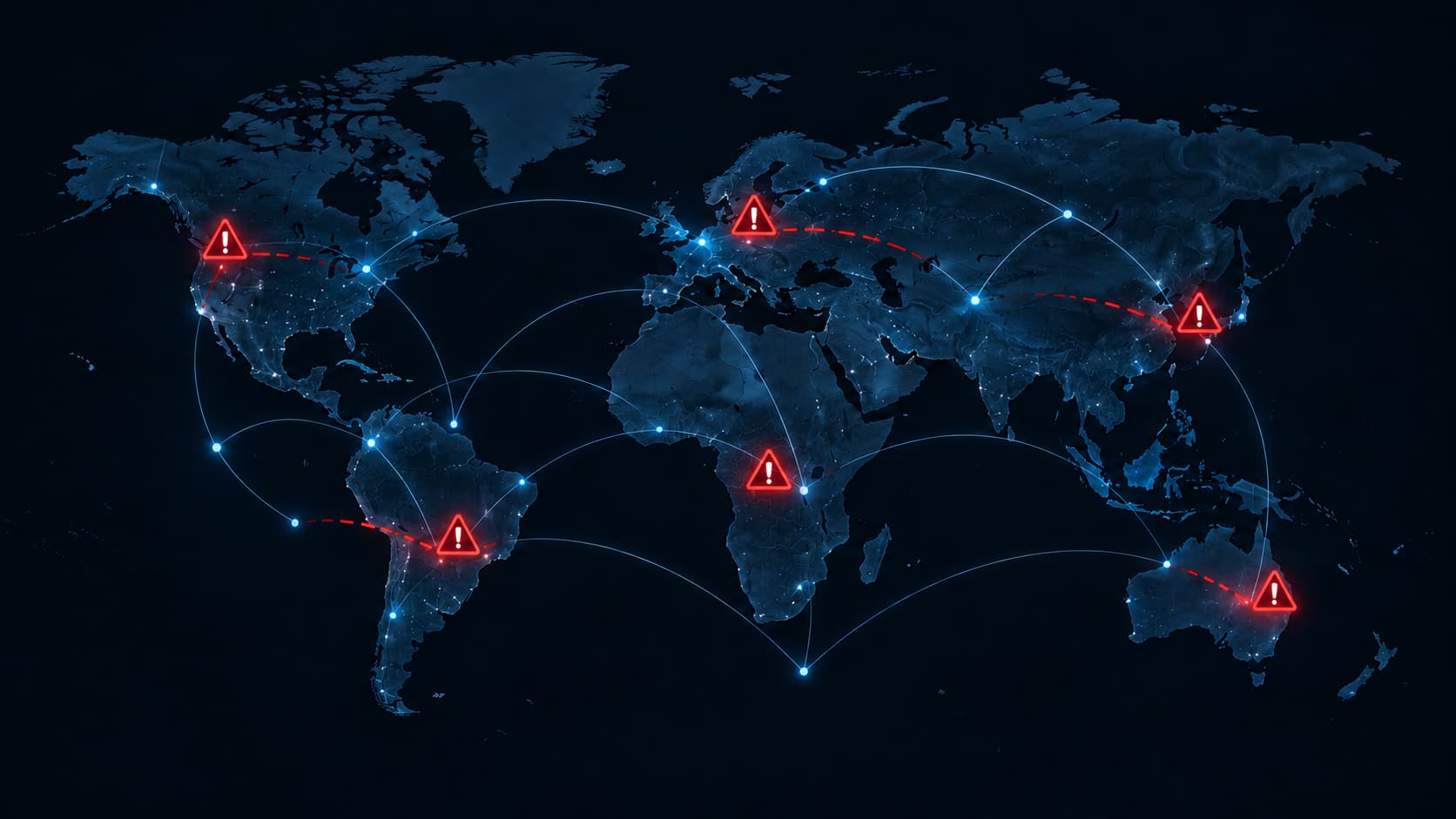
Here is the part that changes the operational model. You send one stream and you receive one stream. Inside the substrate we run diverse paths and merge them at the egress with a time-aligned de-duplication. When a path degrades or drops entirely, the surviving path covers it and the output does not flinch: seamless failover, no interruption, and no loss at the output, measured at our egress. That behavior is validated in continuous operation across real multi-path failover, not asserted from a diagram. You never provision, monitor, or pay for the second circuit, because the second path lives inside the service. If a flagship feed justifies even more diversity, diverse dual feeds in and out of our points of presence are an optional layer on top.
A transponder never told you anything about itself until it failed. The substrate instruments every hop for latency, packet continuity, and loss, so the path is visible, not something you take on faith.
We don't publish one network-wide transit number. Transit time depends on the corridor, and a single average would describe no real deployment. What we publish is overhead: how much time we add above the physical floor for that corridor. Across the corridors we instrument, the median runs about 1.7 times the fiber-path minimum, and our best corridors run closer to 1.2 times. That floor is the great-circle distance between two locations, traveled at two-thirds light speed in single-mode fiber. We quote the band and median together because a range from our best corridors wouldn't describe the network, and every corridor reads at or above its own floor, a check anyone can verify.
Your exact figure lives in the portal, tied to your locations. It covers ingress to egress across our network only, measured leg by leg. Your last mile and any protocol buffer for retransmission or jitter sit outside that boundary; both are real, just not ours to claim.
Good, bring them. It is worth being straight about what a core network can and cannot do at the edge, because that is where most of the pain gets attributed.
We do not claim to fix the physical last mile; nobody re-trenches your access circuit from a network operations center. But most of what presents as last-mile pain is not the access line. It is congestion at the carrier peering points between that access provider and the rest of the internet: a saturated interconnect at one time of day, which from the receiver looks exactly like a bad local loop. The substrate measures those interconnects continuously and re-paths around a congested one, with no action required from you and none from your carrier.
The C-band transition is the flagship North American application of the Media Substrate but this same solution applies worldwide. The substrate replaces a domestic satellite hop, and carries feeds between all the markets we serve, London to Singapore, Sao Paulo to Madrid, on the same network with the same built-in redundancy. NetActuate operates in more than 50 locations worldwide, with a presence in every major North American media market, and is consistently ranked among the largest globally peered IPv4 and IPv6 networks by peer count. Solve the auction deadline this year, and the network you land on is the one that carries you internationally, and the one that answers the same spectrum question.
The way to evaluate this is on your own feeds. Point a contribution stream at our footprint over the protocol you trust, use your own receivers, and ask us to take a path down mid-stream while you watch the output hold. To scope a trial or an architecture review for your transition plan, book an exploratory call with our experts.

.png)
.png)







.jpg)