Browse 110+ Media and Streaming Appliances on the NetActuate Media Marketplace
Explore


Browse 110+ Media and Streaming Appliances on the NetActuate Media Marketplace

By clicking "Accept all" you allow cookies that improve your experience on our site, help us analyze site performance and usage, and enable us to show relevant marketing content. You can manage cookie settings below. By clicking “Confirm selection” you agree with the current settings.

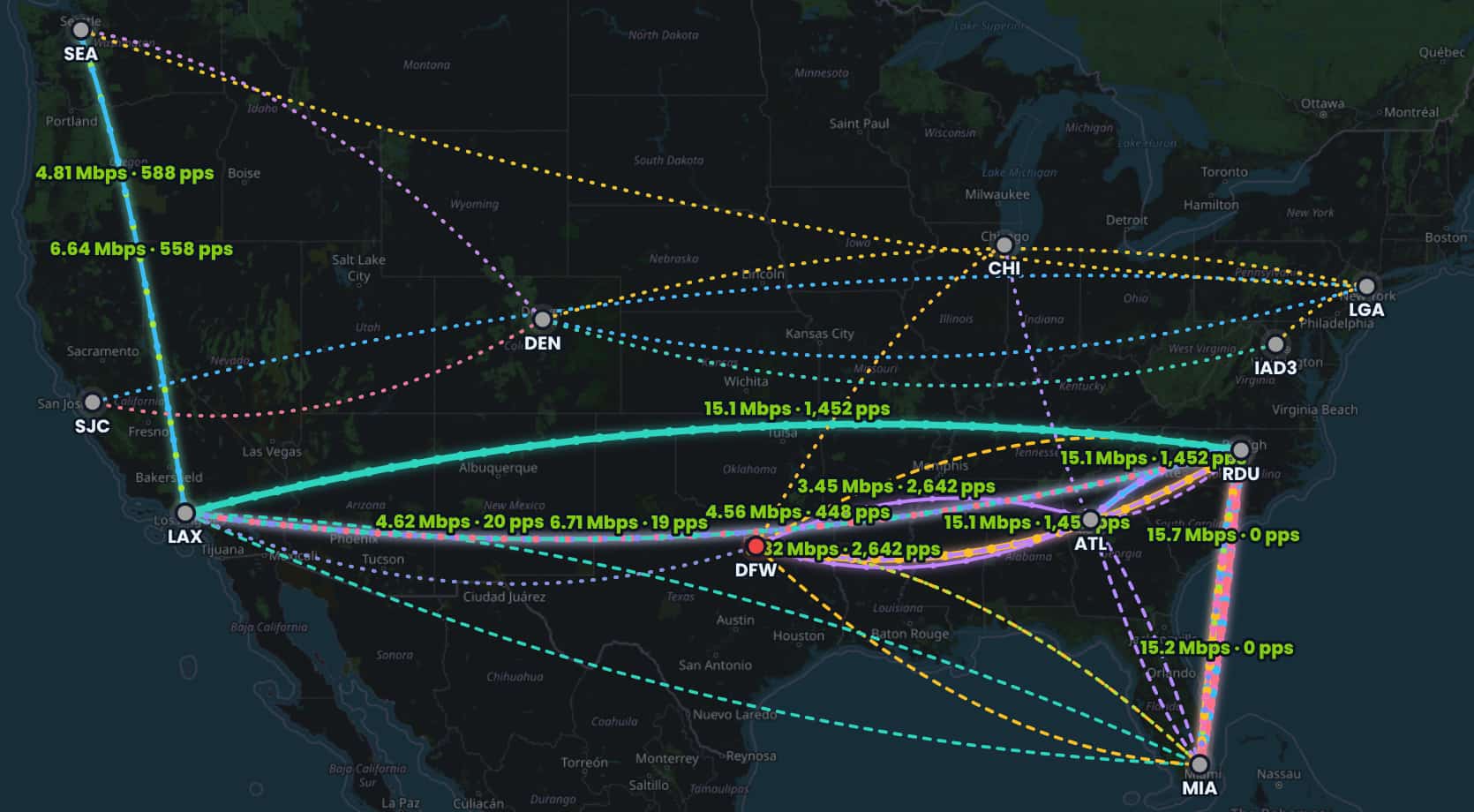
The NetActuate Media Substrate is a managed anycast transport service for contribution-grade and primary-distribution live video, running on a network we operate worldwide. Bring your own encoder and your own protocol. We carry the stream between markets and continents, absorb the redundancy so you send one stream and receive one stream, and hand you back a clean, accounted-for path. Launching at IBC 2026.
Live video is a global business. A feed originates in London and has to be on air in Singapore. A rights holder in Sao Paulo sells a match into Madrid. A programmer in New York opens a channel in Tokyo. And every conversation about moving those feeds starts a layer too high. Teams debate SRT versus RIST, argue about Media over QUIC, compare encoders and receivers. All of that matters, but none of it answers the question that decides whether a live feed holds: what is the network underneath doing to my stream, and what does it do the moment a path degrades somewhere between continents?
Between markets, the traditional answers are unattractive. Build and operate your own international network, which nobody wants to do just to move a feed from London to Singapore. Lease managed circuits route by route and carry the cost whether the event runs or not. Or push the stream across the open internet and hope. The protocol can mask some of what the path does. It cannot fix the path.
The NetActuate Media Substrate is that layer, delivered as a managed service. You bring your encoder and your protocol. We carry the stream across a network we own end to end and hand you a single clean output, in the same market or on the other side of the world.
This works because the network is the product, not an overlay rented on someone else's backbone. NetActuate runs its own ASN and its own BGP control plane across a global anycast footprint, so the route beneath your transport is something we can see and steer in real time rather than a black box handed to a transit provider. When a path degrades, the substrate routes around it on address space we control. Bring your own protocol; we deliver the path.
Redundancy is built in and absorbed by the operator. You send one stream and you receive one stream. Inside the substrate we run diverse paths and merge them at the egress with a time-aligned de-duplication. When a path degrades or drops entirely, the surviving path covers it and the output does not flinch: seamless failover, no interruption, and no loss at the output. This is validated in continuous operation across real multi-path failover. It is also worth being precise about where that number comes from: we measure ingress to egress across our own network, per leg, every hop. Your last mile at either end, and any protective buffer your protocol adds, are separate things that we do not fold into our figures. You never provision, monitor, or pay for a second circuit, because the second path lives inside the service. Customers who want still more diversity can add diverse dual feeds in and out of our points of presence as an optional layer over an already redundant substrate.
The substrate is protocol-agnostic. We have instrumented eleven protocols on one framework, SRT, RIST, UDP, MPTS, MoQ, ST 2022-7, SMPTE ST 2110, RTMP, WebRTC, WHIP and WHEP, and new protocols slot in as thin adapters. Standardize on whatever your workflow trusts; the same transport carries it, and the quality of the path is attributable to the network, not to a re-wrap.
NetActuate operates in more than 50 locations worldwide, including a presence in every major North American media market, and is consistently ranked among the largest globally-peered IPv4 and IPv6 networks by peer count. The substrate itself is not a fixed set of pre-built sites. We deploy it into the locations your traffic needs, drawn from that catalog, and extend it to further locations on request. So the reach question is not how many sites we have lit, it is where you need to be.
Getting onto it is shaped by the customer. The options are:
1. Connect over the public internet to our nearest point of presence.
2. Take dedicated pipes and circuits, which we own the network to sell.
3. Let us manage the last-mile circuit for you.
4. Combine a LEO service such as Starlink with a fixed line into our feed.
5. Layer on diverse dual ingress and egress where a feed justifies the premium. If you already have dedicated pipes, they plug in; if you have nothing but an internet handoff, that works too.
We are careful about what we claim on the last mile. We cannot re-trench your access circuit, and we do not pretend otherwise. But most of what presents as last-mile pain is not the access line at all, it is congestion at the carrier peering points between that provider and the rest of the internet, and that we do measure continuously and re-path around, with no action required from you and none from your carrier. Where the access line genuinely is the problem, the five options above are the commercial answer.
Deployment follows the same logic. The Managed Media Substrate, the default tier, turns up dedicated transport quickly with your own address on our footprint. The Custom Media Substrate gives you a customer-specific network identity and address space, scoped the way you want it, North America, global, or a specific set of countries, and subdivided across your downstream sites.
In North America the substrate arrives with a deadline attached. The 2025 One Big Beautiful Bill Act set an upper C-band auction for July 2027, and US broadcasters are moving contribution and primary distribution off satellite now. They are pointing the encoders they already trust at the substrate and letting it do what the transponder used to do. It is the flagship North American application of a global product, and the same substrate that replaces a domestic satellite hop carries a feed from London to Singapore. Reclaiming spectrum for mobile is a global and recurring event that each region reaches on its own clock, and the US transition simply has the nearest deadline, which makes it the reference case for everyone whose clock starts later. Part of the Media Substrate is a C-Band Transition Acceleration Service that provides the layer underneath the protocol. The encoders and the contribution protocols are ready. SRT and RIST are accredited and in daily operation.
Media over QUIC is the standards-based path distribution teams are evaluating as they leave satellite, and it scales through relays. Relays are infrastructure, and somebody has to run them. We do, as a service in its own right: the NetActuate MOQ Relay is a managed Media over QUIC delivery network on the same network as the substrate. Publish a track once, subscribers pull it from the relay nearest them, and you read a delivery record per hop and per track from the same store our own operations reads. Publishers and subscribers reach one anycast address and land at the nearest relay ingress; the session is then pinned to that location's stable unicast address, so the route beneath a live session can change without the session being torn down. It composes with the Media Substrate and it does not require it.
The way to evaluate a transport layer is on your own workflow. Point a feed at our footprint from your market, receive it in another, run the protocol you trust, and ask us to take a path down mid-stream while you watch the output hold. Arrange an IBC 2026 briefing or book an exploratory call with our experts.

.png)
.png)





.jpg)